March 6, 2026personDr. Monika Diaz, PhDschedule5 min readvisibility62 views
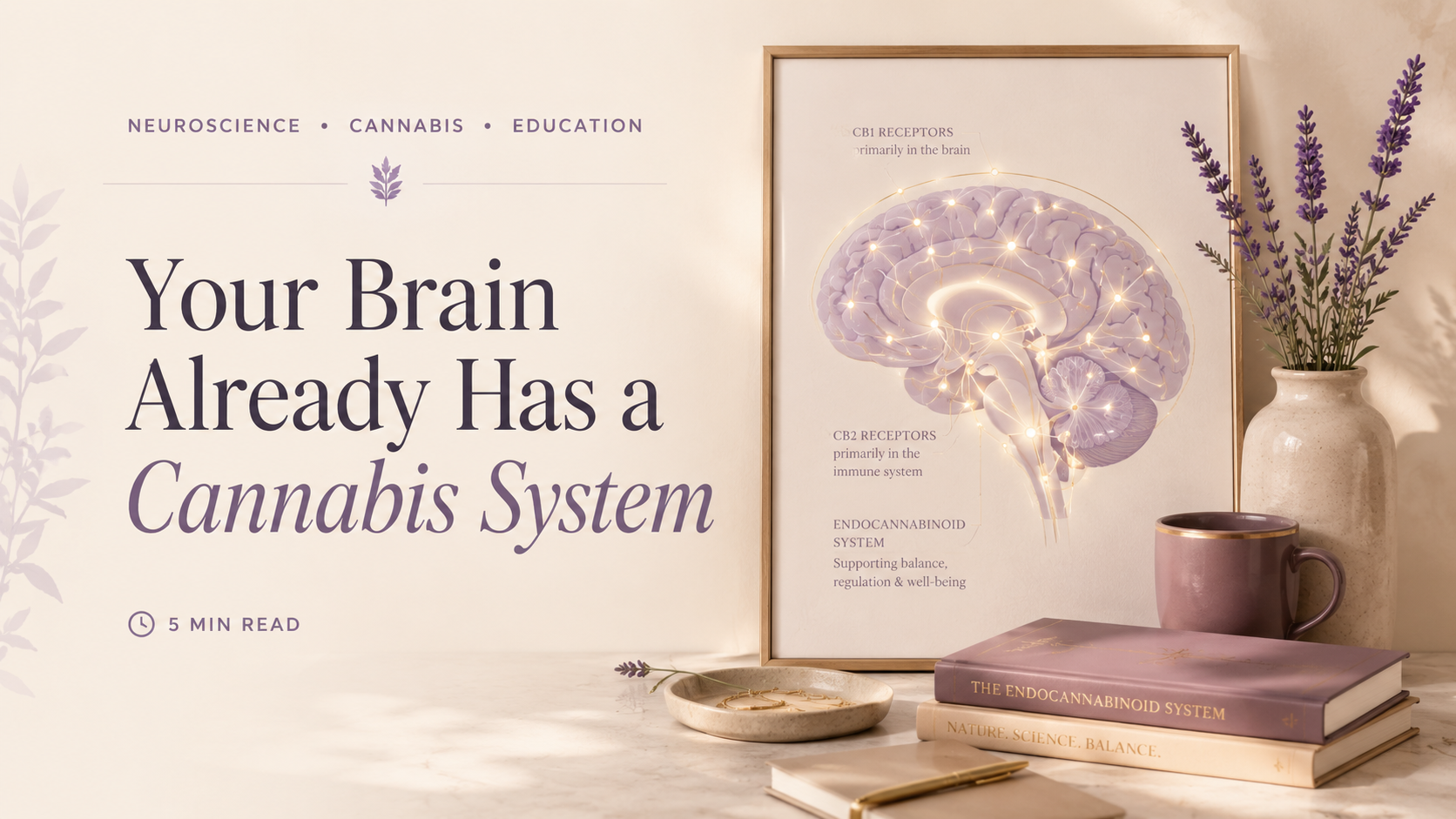
Your Brain Already Has THC Receptors… So Let's Talk About That.
Walk into almost any corner store now and it looks like Willy Wonka opened a cannabis lab.
THC gummies. THCA flower. Delta-8 drinks. Chocolate bars. Sour ropes. Candy that suspiciously looks like it was designed by a 13-year-old marketing intern.
And the messaging usually sounds like this:
"Relax." "Sleep better." "Chill out."
But almost no one explains why your brain even reacts to THC in the first place.
Because here's the wild part.
Your brain already has receptors designed to respond to cannabis-like chemicals.
Not because we evolved for dispensaries.
Because your body built an entire system for balance.
Your body runs a network called the endocannabinoid system (ECS).
Think of it like the neuroscience version of a thermostat.
Too much stress? It helps turn it down. Pain signals too loud? It helps soften them. Inflammation going wild? It nudges things back toward center.
It's one of the systems responsible for homeostasis, which is science language for: "Let's keep things from spiraling into chaos."
This system works through two main receptors: CB1 & CB2
CB1 receptors Mostly in the brain and nervous system. These influence things like:
• mood • memory • appetite • pain perception • coordination
CB2 receptors More connected to the immune system and inflammation response.
Your brain and body use these receptors all day long without you ever noticing.
Your Brain Makes Its Own Cannabis
Before dispensaries existed… before smoke shops… before someone decided THC should come in gummy bear form…
Your brain was already making its own cannabis-like chemicals.
Two big ones:
Anandamide – nicknamed the bliss molecule
2-AG – a regulator of brain and immune signaling
These chemicals show up when your body needs them, do their job quickly, and disappear.
Your brain basically says: "Alright everyone calm down. That's enough stress for today."
And then the system resets.
Elegant. Efficient. Very controlled.
THC works because it looks chemically similar to the cannabinoids your brain already makes.
So when THC enters the bloodstream, it basically walks up to those CB1 receptors and says:
"Hi. I belong here."
And the receptor goes:
"Close enough."
The difference?
Your brain normally releases cannabinoids in tiny, carefully measured bursts.
THC shows up like someone turned the volume knob all the way up.
That's why people can experience things like:
• relaxation • altered perception • the giggles • intense hunger • slower reaction time • short-term memory glitches
Or sometimes…
• anxiety • racing thoughts • paranoia
The receptor is doing exactly what it was designed to do.
It's just being pushed harder than usual.
Now Let's Talk About THCA (Because Stores Love This One)
You'll see this everywhere right now.
THCA flower THCA concentrates
And the marketing line usually sounds like: "It's not psychoactive."
Technically… that's true.
THCA (tetrahydrocannabinolic acid) is the raw form of THC found in cannabis plants.
By itself, it doesn't produce the classic "high."
But the second heat enters the picture—smoking, vaping, lighting it—
THCA converts into THC.
That process is called decarboxylation.
Which is science for: "The moment you light it, it becomes THC."
Why Your Brain Chemistry Actually Matters Here
The endocannabinoid system interacts with brain areas responsible for:
• emotional regulation • memory formation • stress response • dopamine signaling
So when THC strongly activates those receptors, the experience can vary a lot depending on:
• dose • brain chemistry • age of the brain • frequency of use
The adolescent brain, for example, is still wiring its prefrontal cortex and dopamine circuits. Those systems are especially sensitive to heavy THC exposure.
Which is why research conversations around cannabis often focus on timing and dosage, not just whether the substance exists.
The Real Takeaway
THC doesn't work because cannabis is magical.
It works because your brain already built the locks.
THC just happens to fit the keys.
The endocannabinoid system was designed to keep the brain and body in balance.
Cannabis simply presses a button that was already there.
Sometimes gently.
Sometimes like someone leaning on the elevator panel with their entire elbow.
You Can Activate These Receptors Without THC
Here's the part that doesn't get advertised on a candy wrapper.
Your endocannabinoid system was not designed to depend on cannabis. It was designed to respond to your behavior, movement, and environment.
In fact, several everyday activities naturally increase the same brain chemicals that THC interacts with.
Movement: Endurance exercise (running, cycling, fast walking) increases anandamide, the same "bliss molecule" that activates CB1 receptors.
This is part of what people call the runner's high. For years scientists thought it was endorphins. Turns out, a lot of it is endocannabinoids.
Laughter & Social Connection: Positive social interaction increases endocannabinoid signaling in the brain's reward and bonding circuits.
Translation: Your nervous system literally stabilizes when you feel safe and connected.
Deep Sleep: Your endocannabinoid system helps regulate sleep cycles and emotional processing. When sleep is disrupted, this system often becomes dysregulated as well.
Consistent sleep helps reset receptor sensitivity.
Nutrition: Endocannabinoids are built from fatty acids, particularly omega-3s. Low omega-3 levels can impair how well this system functions.
Stress Reduction: Chronic stress can reduce endocannabinoid signaling. Practices like meditation, breathwork, and time in nature help restore balance. Your brain literally recalibrates.
Cannabis doesn't create the system.
It taps into a system that already exists.
And while THC can stimulate those receptors externally, your brain is fully capable of activating them internally through behavior, lifestyle, and environment.
Which is actually pretty remarkable when you think about it.
So if cannabis is something you enjoy responsibly, there's no need to suddenly clutch your pearls and panic.
Just know this:
Your brain already built the system.
THC just happens to know where the doorbell is.
And science is always happier when people understand the wiring behind the experience. -Dr. Monika Diaz, PhD
Enjoyed this article?
Get notified when we publish new insights.