April 8, 2026personDr. Monika Diaz, PhDschedule10 min readvisibility78 views
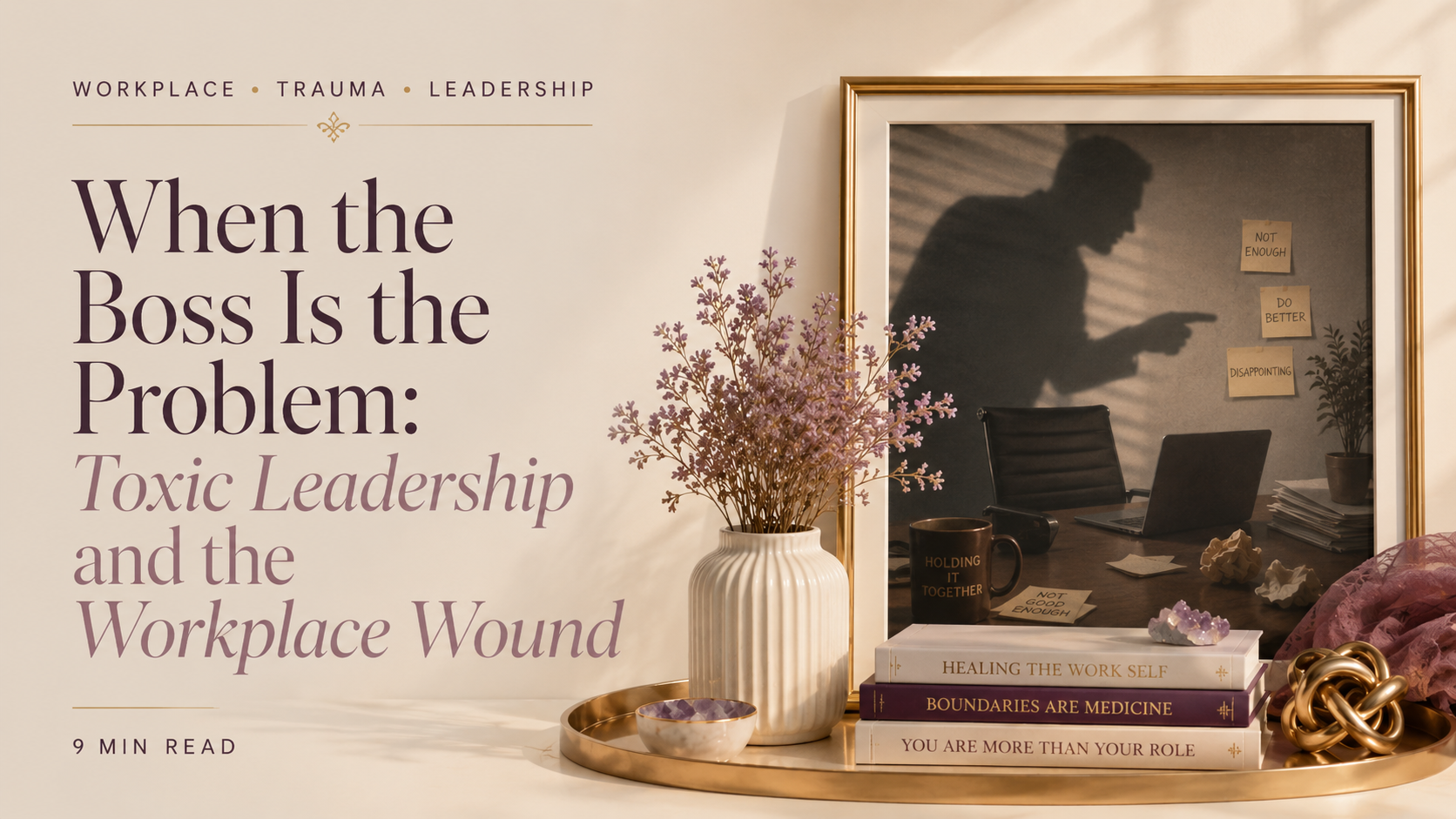
When the Boss Is the Problem: Toxic Leadership and the Workplace Wound
Toxic leadership isn't just bad management — it's a documented psychological harm. Here's what the research says, how every generation survives it differently, and what's coming next.
By Dr. Monika Diaz, PhD · Perkins PsyCare
You know the feeling. You check your phone Sunday night and your stomach drops — not because of anything that happened, but because tomorrow happens. You walk into work already bracing for something. You measure your words before you speak them. You've stopped offering ideas in meetings. You've started calling it "just the job."
That's not just stress. That's what a toxic work environment does to a person over time — and if there's a bad leader at the top of it, the damage runs deeper than most people realize.
Let's talk about what's actually happening — clinically, generationally, and organizationally — and where this is all headed.
"Toxic" Isn't Just a Buzzword — Here's the Clinical Definition
Everyone uses the word "toxic" now. It's on TikTok, in HR memos, in Glassdoor reviews. But in the psychological literature, there's a more precise term: destructive leadership.
Researchers define it as a pattern of behavior in which a leader systematically undermines the well-being, goals, and effectiveness of both employees and the organization itself. It's not a bad day. It's not a manager who gives hard feedback. It's a sustained, repeated set of behaviors — intimidation, manipulation, credit-stealing, humiliation, gaslighting, and fear-based control — that erode people from the inside out.
A 2024 comprehensive review published in the International Studies of Management & Organization describes toxic leaders as those who "unpredictably exhibit extreme emotions, lack emotional intelligence, are insensitive and self-centered, and employ negative managerial tactics to influence followers." That's not a quirky boss. That's a clinical pattern.
The psychological consequences are well-documented: anxiety, depression, emotional exhaustion, burnout, hypervigilance, and in some cases, symptoms that mirror complex trauma responses. Research also links toxic leadership environments to elevated cardiovascular risk — your body is keeping score whether your HR department is or not.
Toxic leadership isn't an HR problem. It's a public health problem.
$300BAnnual cost of toxic leadership-related job stress in the U.S.
80%of workers say they're in a toxic work environment (Monster, 2025)
57%would quit rather than stay in a harmful environment
The Toxic Triangle: It's Not Just the Boss
Here's something a lot of people miss: toxic workplaces aren't created by one bad leader alone. Researchers Padilla, Hogan, and Kaiser identified what they call the Toxic Triangle — three conditions that have to coexist for a destructive environment to take root.
A destructive leader — someone with narcissistic, manipulative, or abusive tendencies who has been given power
Susceptible followers — employees who conform out of fear, or who enable the leader's behavior because it benefits them short-term
A conducive environment — an organization with weak accountability, unclear ethics policies, or a culture that rewards results over how people are treated
Toxicity doesn't just flow from the top down. It spreads horizontally. Some employees become enforcers — carrying out the leader's behavior to survive it. Others become witnesses who go silent to stay safe. Others leave — and the cycle repeats with whoever stays.
In public sector and state government settings specifically, that conducive environment piece is worth paying close attention to. Bureaucratic structures and limited accountability mechanisms can sometimes inadvertently protect toxic leaders just as effectively as they protect employees.
How It Shows Up: At the Top and Across the Team
Researcher Pelletier identified eight core dimensions of toxic leadership behavior. Run through this list and see if any of it sounds familiar.
Attacking employees' self-esteem through ridicule, mockery, or public humiliation
Taking credit for others' work and being openly deceptive
Verbal abuse — yelling, belittling, sharp and cutting language
Social exclusion and deliberately isolating certain employees
Micromanaging to the point of undermining autonomy
Creating an environment of fear and unpredictability
Favoritism and inconsistent application of rules
Self-promotion at the expense of team integrity
Now here's the part that often gets overlooked: what happens to the staff below it.
Employees in toxic environments don't just suffer passively. They adapt — and not always in healthy ways. Some become hypervigilant people-pleasers. Some disengage entirely. Some turn on each other, competing for the one thing that feels safe: the leader's approval. Some develop what I'd describe as a kind of organizational PTSD — chronic low-grade stress that follows them home, into their sleep, into their next job.
A 2025 survey from iHire found that over 62% of employees in negative workplace cultures are afraid to speak up and share their opinions. More than half reported that unethical practices were openly accepted. That's not dysfunction. That's a culture that has learned to protect itself by going quiet.
The Generational Survival Chart: From Parking Lots to Posted Screenshots
How people cope with a bad boss has everything to do with when they grew up — what was modeled for them, what was culturally acceptable, and what tools they had available. Let's walk through it.
Silent Generation (born 1928–1945): Handle It and Come Back Monday
There's a reason they're called the Silent Generation. They survived the Depression and World War II. Work was transactional — you showed up, you did your job, you went home. Conflict resolution? That could look like a confrontation in the parking lot after hours. It was direct, and then — remarkably — it was over. You came back to work Monday and you got on with it.
There was a certain raw pragmatism to it that, looked at from a clinical lens, was actually a form of direct conflict resolution. Messy? Absolutely. But it was over. The emotional labor of this generation was carried internally and silently. Mental health wasn't a conversation. You survived — because you'd already survived much worse.
Baby Boomers (born 1946–1964): Loyalty Over Sanity
Boomers grew up in a post-war economic expansion where loyalty to your employer was a virtue and job security was the ultimate goal. They didn't just tolerate difficult bosses — many genuinely believed that was the price of professionalism.
"You don't air your dirty laundry." "That's just how it is." "I've put 20 years into this company." These aren't just phrases — they're a survival philosophy. A 2022 EY generational survey found that less than 30% of Boomers said company culture impacted their decision to stay — compared to 40% of younger workers. That's not indifference. That's a generation that was never taught to expect anything different.
Generation X (born 1965–1980): The Latchkey Stoics
Gen X came up largely on their own — the highest divorce rates in American history, dual-income households, the rise of the latchkey kid. They weren't going to trust institutions, and they weren't going to emotionally invest in a workplace that might not invest back.
Their response to toxic leadership? Quiet indifference. Keep your head down. Do your work. Collect your paycheck. Gen X perfected the art of detached professionalism — staying employed while staying emotionally disengaged. They didn't fight back loudly; they just found ways to operate autonomously and survive the dysfunction.
Millennials (born 1981–1996): The First to Name It
Millennials entered the workforce full of idealism and got hit with the Great Recession, crushing student debt, and a job market that asked for loyalty it wasn't prepared to return. And then something shifted — they started naming what was happening to them.
Millennials were the first generation to broadly use the word "toxic" in the workplace context. They drove the Great Resignation. Research published in 2025 found that Gen Z and Millennials hit peak burnout at just 25 years old, compared to the average American who reaches it at 42. Something isn't working, and Millennials have been the loudest voice saying so.
Generation Z (born 1997–present): They Will Not Stay Silent — and They Have Wi-Fi
Gen Z grew up watching their parents burn out, seeing mental health crises unfold on social media in real time, and entering the workforce during a global pandemic. They arrived knowing the language of trauma, boundaries, and psychological safety before most HR departments did.
They will quit without a backup plan. They will name the environment publicly. They will organize — union participation among workers under 30 is at levels not seen since the 1960s. According to a 2025 APA report, 61% of Gen Z respondents said they'd strongly consider leaving a job for one with better mental health benefits. That's a generation that learned — from watching every generation before them — that silence is not survival.
The I/O Clinical Lens: What This Is Actually Costing
From an Industrial-Organizational (I/O) psychology perspective, the workplace isn't just a place people go — it's a system that either supports or degrades human functioning. And right now, a significant number of those systems are under serious strain.
The APA's 2025 Work in America survey found that a majority of U.S. workers — 54% — say job insecurity is significantly impacting their stress levels. For state and government employees specifically, 53% anticipate significant organizational changes due to policy shifts. That anticipatory stress — the waiting — is often more psychologically damaging than the event itself.
From a clinical I/O standpoint, what's happening in many organizations is a collapse of psychological safety — the shared belief that the workplace is safe for taking interpersonal risks. When people don't feel safe to speak up, flag problems, or admit mistakes, innovation dies, quality suffers, and people get sick.
Research from PwC's 2025 Global Workforce survey found that employees with the highest psychological safety are 72% more motivated than those with the lowest. The inverse tells a similarly clear story.
The Next 5 Years: What Organizations and Employees Need to See Coming
I/O psychologists, HR leaders, and organizational researchers are watching several converging trends that will fundamentally reshape what "work" means — and what leadership accountability looks like — by 2030.
Gen Z Will Become the Majority Voice
As Baby Boomers retire and Millennials move into senior roles, Gen Z will make up the largest active share of the workforce within the next five years. Organizations that haven't adapted their leadership culture to meet this generation will face a retention crisis they cannot hire their way out of.
Psychological Safety Will Become a Measurable Standard
What was once a "soft" concept is being operationalized. Expect to see psychological safety audits, leadership toxicity assessments, and mental health metrics included in organizational performance reviews — not just as goodwill, but as regulatory and liability frameworks evolve to require them.
The Union Revival Is a Symptom Worth Paying Attention To
When workers organize, they're telling you something. The resurgence in union activity — especially among younger workers — is a direct response to eroded trust in leadership and institutional accountability. For public sector and state employees, this conversation is already underway.
Toxic Leadership Will Start Costing Leaders Their Roles
As documentation becomes easier, as HR frameworks tighten, and as organizations tie leadership evaluations to employee well-being data, the days of the toxic manager being quietly shuffled to another department are numbered.
I/O Psychology Will Move From Advisor to Architect
The next five years will see Industrial-Organizational psychologists playing a much more central role in how organizations are designed — not just how people within them are trained. From hiring protocols that screen for dark triad traits in leadership candidates, to restructuring that distributes power more equitably, the clinical lens is moving upstream.
The question is no longer whether toxic leadership harms people. The research settled that. The question is whether organizations are willing to treat it as the emergency it is.
If you're a state employee, a manager, or an organizational leader reading this — the generational handoff is already happening. The question isn't whether your team will demand a healthier environment. It's whether you'll be ready when they do.
And if you're an employee who's been surviving instead of thriving — that word is important. Surviving isn't enough. What you're experiencing has a name, it has research behind it, and it has an antidote.
You Don't Have to Figure This Out Alone
At Perkins PsyCare, we work with individuals navigating the psychological toll of difficult work environments — and with organizations ready to do better. If any of this resonated, we're here.
Reach us at perkinspsycare.com or give us a call to start the conversation.
Enjoyed this article?
Get notified when we publish new insights.