March 5, 2026personDr. Monika Diaz, PhDschedule5 min readvisibility71 views
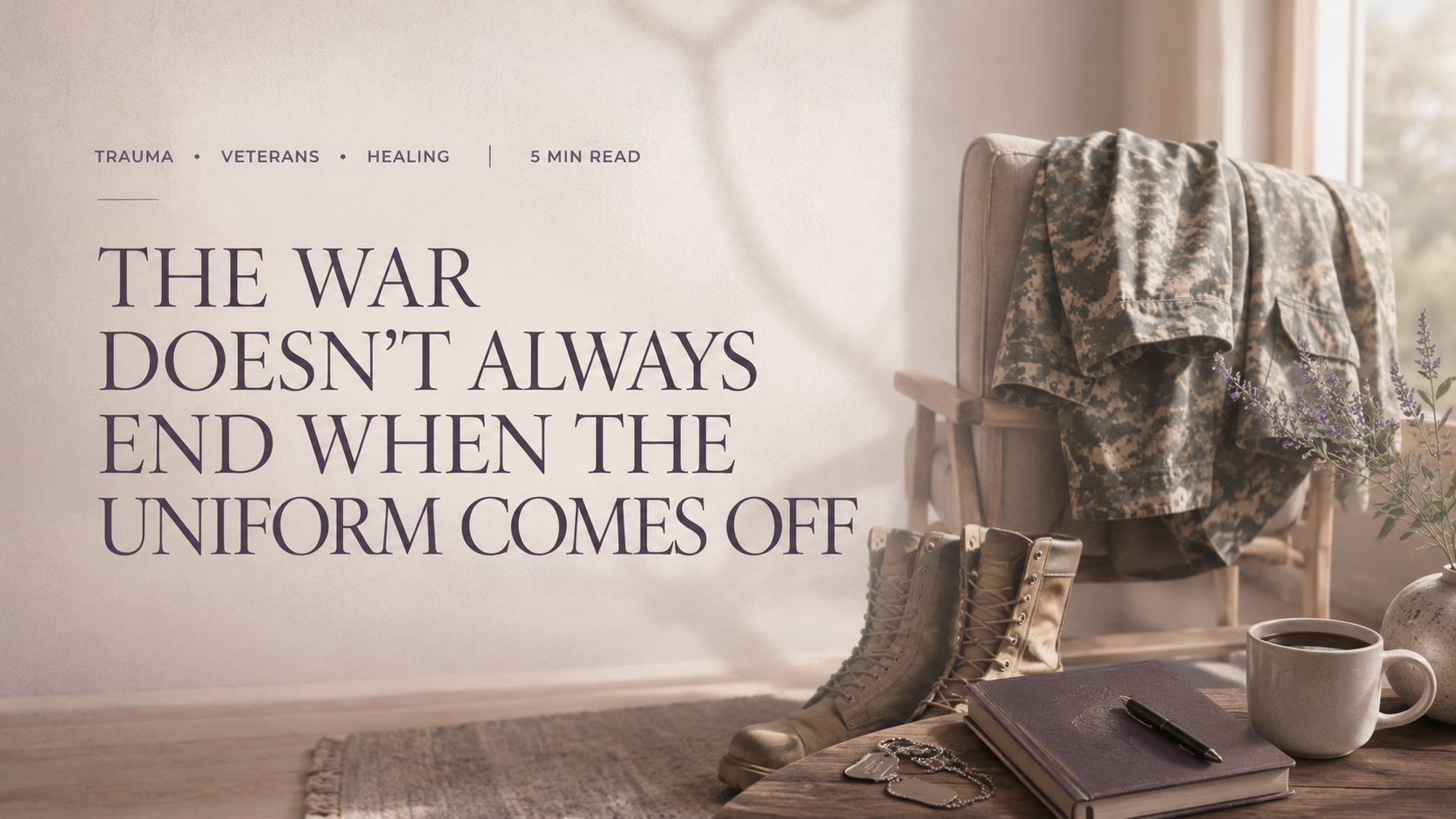
The uniform comes off.
The boots are stored away. The weapons are no longer within reach. The mission briefings stop.
From the outside, it looks like the war is over.
But for many veterans, the nervous system never received that memo.
PTSD does not always arrive as dramatic flashbacks or visible panic.
Often, it enters quietly—through something small, almost forgettable.
A sound. A smell. A breath too close to your ear.
Maybe you're sitting at the kitchen table with family.
Everyone is relaxed. The house is quiet.
Then you hear it. Someone next to you is breathing heavily.
At first, it's subtle. Then it becomes impossible to ignore.
You feel irritation rising. Your chest tightens.
Your patience disappears almost instantly.
You snap, or you get up and leave the room.
Later, when the moment passes, you think to yourself: Why did that bother me so much?
To everyone else, it was just breathing.
To a veteran's nervous system, it might have been something entirely different.
In military training and combat, breathing is not just a biological function. It is a survival tool.
Every marksman learns the same principle: control your breathing or you miss the shot.
You inhale. You exhale. You fire between breaths.
Breathing becomes discipline. Control. Precision. Survival.
Because if you cannot fire accurately, you cannot protect the person next to you.
And if you cannot protect the person next to you, people die.
The nervous system learns these lessons with absolute seriousness.
Years later, sitting safely in a living room, the body may still react as if that rule is active.
When someone nearby breathes loudly or irregularly, the brain may interpret it not as a harmless human sound—but as a signal of lost control.
The reaction is instantaneous, emotional, and often confusing.
The logical brain says, "This is nothing"
The nervous system says, "This matters."
Bessel van der Kolk writes in The Body Keeps the Score: "The body keeps the score. If the memory of trauma is encoded in the viscera, in heartbreaking and gut-wrenching emotions, in autoimmune disorders and skeletal muscle problems, it simply will not yield to words."
Trauma is not stored like a normal memory.
It is stored in the nervous system.
People imagine PTSD triggers as dramatic moments—fireworks, helicopters, explosions.
Those certainly exist.
But more often, triggers are subtle.
A creaking garage door.
A sudden movement behind you.
A car backfiring.
A breathing pattern that feels wrong.
The brain learned, during combat or training, that tiny details matter.
Survival often depended on noticing what others missed.
That vigilance does not simply disappear once service ends.
Van der Kolk explains it this way: "Traumatized people chronically feel unsafe inside their bodies." So when the body senses something unfamiliar—or something that once meant danger—it reacts before the conscious mind has time to evaluate the situation.
The result is irritation. Hyper-alertness. Sudden anger. A need to leave the room. Then comes the confusion afterward. "Why did I react like that?"
Military service trains the nervous system to stay alert, controlled, and ready.
That training is extraordinarily effective in combat.
But in civilian life, the same responses can feel out of place.
The nervous system is still scanning.
Still calculating.
Still asking the same question it asked in combat: Is this safe?
For many veterans, the hardest part of the transition is not the memories of war.
It is learning how to turn the nervous system down after years of learning how to turn it up.
Many veterans carry a quiet belief that they deserve the weight they're carrying.
That because friends didn't make it home—because a brother or sister in arms was killed right in front of them—they are supposed to live with these feelings.
That the anger, the guilt, the memories, the sleepless nights… are something they have to wear for the rest of their lives in honor of those who didn't make it back.
But trauma is not a debt that has to be paid forever.
The nervous system that learned to survive war did exactly what it was trained to do.
PTSD is not a failure of character. It is the cost of training a human mind and body to endure unimaginable circumstances.
And healing isn't forgetting those who were lost.
It's allowing the nervous system to learn that the mission has changed—and that survival does not have to mean suffering forever.
When the Uniform Comes Off
The world sees the veteran without the uniform.
But inside the body, the training, the vigilance, and the memories may still be present.
Sometimes they appear as anger.
Sometimes as exhaustion.
Sometimes as irritation over something as small as a breath.
Understanding that reaction—not judging it—is where healing begins.
Because the truth many veterans eventually discover is this:
The nervous system that once learned how to survive war can also learn how to live in peace again.
It just needs time.
And the right kind of support.
Trauma does not live only in memory.
It lives in the body, in the breath, in the nervous system's quiet calculations about safety and danger.
But the same body that learned survival can also learn recovery.
And sometimes, the first step is simply understanding why something as small as a breath can feel so loud.
Some veterans believe the pain is the price they owe for surviving. But honoring the fallen was never meant to mean suffering forever. -Dr. Monika Diaz, PhD
Enjoyed this article?
Get notified when we publish new insights.