March 5, 2026personDr. Monika Diaz, PhDschedule5 min readvisibility52 views
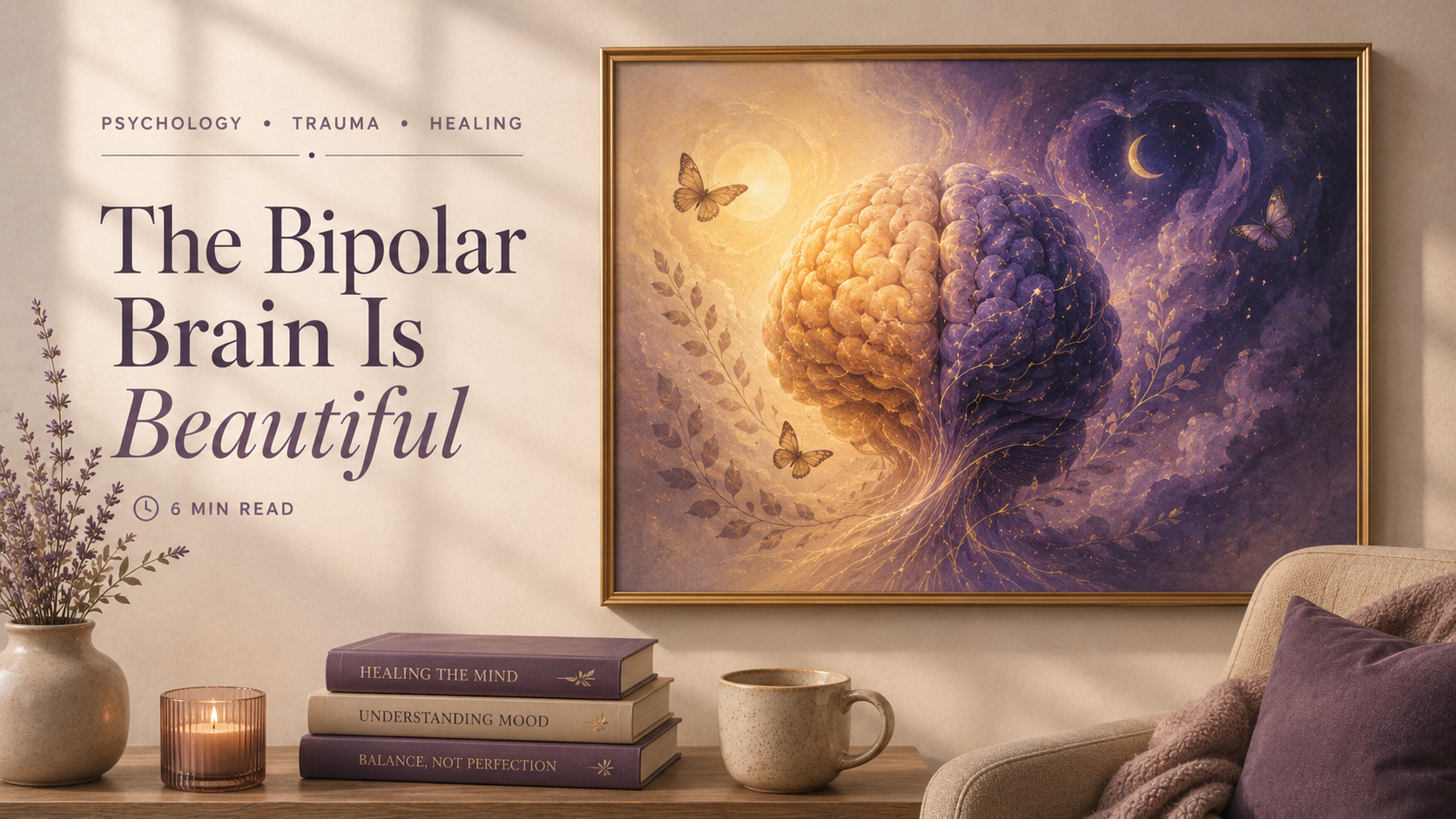
The Bipolar Brain Is Beautiful. The Rap Sheet It Carries Isn't Accurate.
For decades, Bipolar Disorder has carried a reputation that sounds more like a criminal record than a medical diagnosis.
People hear the word bipolar and imagine someone uncontrollable. Angry. Reckless. Unstable. Someone who changes moods every few seconds.
But that description isn't clinically accurate.
And more importantly — it isn't fair.
Bipolar Disorder is not someone being angry one minute and sad the next. That pattern is more consistent with emotional dysregulation often seen in Borderline Personality Disorder. Bipolar mood episodes occur over days, weeks, or longer, not minutes.
The bipolar brain is something very different.
It is a brain that has carried extraordinary neurological load.
Sometimes genetics play a role. Bipolar disorder has one of the strongest hereditary links in psychiatry. Sometimes trauma contributes. Sometimes the nervous system learned to live in survival mode for far too long.
But what results is not a broken brain.
It is an overworked brain.
It's a brain that processes emotion, stimulation, ideas, and experiences at an unusually intense level.
One of the most harmful stereotypes is that people with bipolar disorder are irresponsible or lazy.
In reality, many individuals with bipolar disorder are exceptionally driven, creative, and high performing.
During manic or hypomanic states, the brain can become flooded with energy, ideas, and motivation. People may enroll in multiple trainings, start businesses, write through the night, compose music, create art, or pursue ambitious goals with extraordinary intensity.
History quietly reflects this.
Many scholars believe that several brilliant historical figures lived with bipolar spectrum conditions:
Vincent van Gogh – whose emotional intensity and shifting mood states were reflected in the vivid movement and color of his paintings.
Ludwig van Beethoven – who composed some of the most emotionally powerful music in history despite severe mood instability and personal suffering.
Virginia Woolf – whose writing transformed modern literature while she struggled with recurring mood episodes.
Carrie Fisher – actor, writer, and outspoken advocate who openly discussed living with bipolar disorder while maintaining an extraordinary creative career.
These individuals were not defined by their diagnosis.
They were defined by how deeply they experienced the world.
The bipolar brain often sees brighter colors, deeper meaning, louder emotion, and more layered reality than most people realize.
From the outside, bipolar disorder can look dramatic.
From the inside, it is often much quieter.
It can feel like carrying a nervous system that runs at full volume.
There are times when the brain feels electric — ideas racing, creativity exploding, possibilities everywhere.
And there are other times when the body feels heavy. Not sadness alone, but deep fatigue. The kind of exhaustion where even breathing the air feels like work.
Some individuals may also experience sensory distortions during severe mood episodes — seeing or hearing things that are not fully grounded in reality, particularly when trauma has been layered into the nervous system.
But even then, the person underneath remains.
Often deeply empathetic.
Often highly perceptive.
Often painfully aware of the world around them.
Many people with bipolar disorder describe feeling like their outer armor is steel, while the inside is made of glass.
Strong enough to keep moving.
Sensitive enough to feel everything.
A common misunderstanding is that stability means eliminating intensity.
But for many people with bipolar disorder, the goal is not to erase their energy or creativity.
It is to learn how to channel it safely.
With proper treatment, individuals learn to recognize early mood shifts, regulate stimulation, and build rhythms that protect the brain without extinguishing its fire.
That is where the real power begins.
Because when manic energy becomes structured ambition, and emotional depth becomes creative expression, people often discover strengths they never realized they had.
Of all the things the bipolar brain needs, sleep is the most critical.
The brain systems that regulate bipolar disorder are closely tied to the body's circadian rhythm, the internal biological clock that regulates sleep, hormones, and mood stability.
When sleep becomes disrupted, the brain's emotional regulation centers — particularly the amygdala and prefrontal cortex — lose coordination.
This can trigger manic or depressive episodes.
For someone with bipolar disorder, missing sleep is not simply being tired.
It can be like removing the stabilizers from an already powerful engine.
Consistent sleep allows the brain to recalibrate neurotransmitters such as dopamine, serotonin, and norepinephrine — the same systems that drive mood episodes.
Protecting sleep protects the brain.
And protecting the brain protects the person.
The diagnosis itself has been treated like something dangerous.
Like something shameful.
Like something that needs to be hidden away.
But labeling bipolar disorder as something destructive is like locking away Vincent van Gogh and calling his paintings a problem.
The same brain that can experience overwhelming emotional waves can also produce breathtaking creativity, insight, leadership, and compassion.
The goal of treatment is not to silence that brain.
It is to support it.
To give it the care, structure, rest, and understanding it deserves.
A bipolar diagnosis does not mean a life out of control. It means a brain that experiences the world at extraordinary intensity.
When that brain receives the care it deserves — sleep, stability, treatment, nourishment, and compassion — it does not become less powerful.
It becomes guided.
And guided power is one of the most extraordinary forces a human being can carry.
The bipolar brain is not broken. It is a brilliant nervous system that simply deserves exceptional care. -Dr. Monika Diaz, PhD
Enjoyed this article?
Get notified when we publish new insights.