March 18, 2026personDr. Monika Diaz, PhDschedule6 min readvisibility83 views
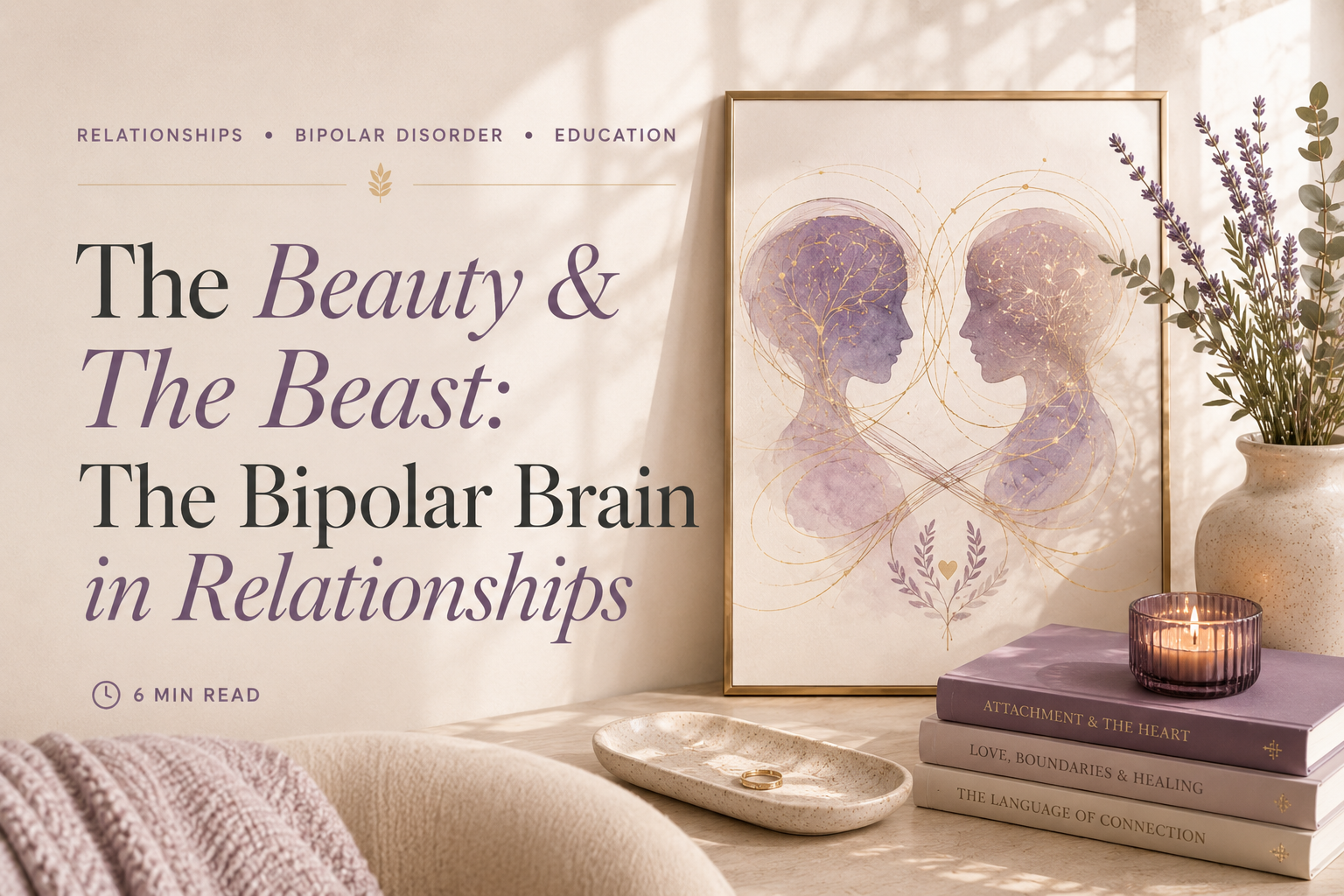
Let's talk about it honestly. Not with clinical coldness. Not with the breathless drama that makes for clickbait. But with the kind of truth that actually helps — the kind that sees the whole person and doesn't flinch.
This isn't a Character Flaw.It's a Brain Difference.
Before we go any further, let's clear the air. Bipolar disorder is not a personality type. It is not moodiness, drama, or a convenient excuse. It is a neurobiological condition — a brain that cycles through states of elevated energy and deep depression, often with stretches of stability in between.
The prefrontal cortex — the brain's CEO, responsible for impulse control and decision-making — functions differently in the bipolar brain. Emotional regulation circuits fire harder. The reward system runs hotter. During manic or hypomanic episodes, dopamine surges. During depressive episodes, it crashes.
This isn't a moral failing. It is biology. And yet, the stigma persists — in whispered conversations, in first dates that never became second ones, in the quiet shame that so many people carry alone.
2.8% of adults worldwide live with bipolar disorder — that's over 200 million people. Many are in long-term, deeply loving relationships. Many are also suffering in silence because the stigma feels louder than the science.
The Beauty:What Nobody Talks About
Here's something the textbooks don't always say loudly enough: the bipolar brain can be breathtakingly beautiful to be in a relationship with.
People who live with bipolar disorder often describe — and their partners confirm — an intensity of love and connection that feels unlike anything else. The hypomanic mind can be magnetic: curious, creative, spontaneous, achingly present. They notice things other people don't. They feel things deeply. They love fiercely.
Research has found higher rates of creativity, empathy, and emotional depth among people with bipolar disorder. The very neurology that creates the storm also creates the sunrise.
Many partners of people with bipolar describe falling in love with exactly that energy — the electricity, the depth, the sense that life is being lived in full colour. Artists, musicians, writers, visionaries. The list of extraordinarily gifted people who lived with bipolar disorder is long, and it is not a coincidence.
↑ 40% higher rates of creative achievement found in studies of people with bipolar disorder vs. the general population
↑ 2× more likely to demonstrate heightened empathy and emotional attunement, according to interpersonal research
The Beast:And Why We Have to Name It
But let's be honest. Because real help requires honesty.
Relationships touched by bipolar disorder can be turbulent in ways that are genuinely hard. During a manic episode, impulsivity can lead to decisions that damage trust — spending, risk-taking, heightened sexuality, grandiosity that crowds out the partner's perspective. During a depressive episode, the person may disappear emotionally — unreachable, flat, sometimes barely able to get out of bed.
For the partner, this can feel like living with two different people. And for the person with bipolar disorder, the shame of what they said or did during an episode can be devastating. They didn't want to hurt you. The illness was driving.
Neither of these truths cancels the other. The beauty is real. The beast is real. And holding both — without collapsing into either romanticisation or despair — is the work of loving wisely.
The goal isn't to pretend there are no hard days. The goal is to build a relationship where both people understand the brain behind the behaviour — and choose each other anyway, with their eyes open.
What Actually Helps:A Clinician's Honest List
Relationships with a bipolar partner don't just survive — they can genuinely thrive. But they need the right tools. Here's what research and clinical practice show actually makes a difference:
Education changes everything. When both partners understand the neuroscience of bipolar disorder — the cycling, the triggers, the biology — it transforms blame into understanding. Knowledge is the antidote to resentment.
Build a shared mood map. Knowing each other's early warning signs — the tells of a coming episode — gives couples time to respond rather than react. Create a plan together, before you need it.
Learn to communicate across states. What your partner needs to hear during a depressive episode is completely different from what lands during stability. Get curious about which version of your partner you're talking to — and adjust.
Protect the stabilisers. Sleep, routine, medication adherence, and reduced substance use are the four pillars of mood stability. A good partner knows this and supports it — not as a warden, but as a team-mate.
Get your own support. Partners of people with bipolar disorder need their own space — therapy, support groups, honest friendships. You cannot pour from an empty cup, and compassion fatigue is real.
Separate the person from the illness. The cruelty during a manic episode is not who they are. The silence during depression is not rejection. Practice saying out loud: "This is the illness. This is not my person."
If You Are the OneWith the Bipolar Brain
You deserve love that doesn't require you to be ashamed of your brain.
You are not too much. You are not broken. You are not a burden. But you do carry something that asks more of your relationships — and that means it asks more of you, too. Showing up for a partner when you have bipolar disorder means committing to your own treatment. It means having hard conversations before crises hit. It means letting someone love you on your dark days without pushing them away.
That takes extraordinary courage. And it is worth it.
The people who love you most are not loving you in spite of your brain. They are loving you — all of you — because of who that brain has made you: deep, fierce, searching, alive.
40+ years of research showing that with treatment and strong relational support, people with bipolar disorder lead full, connected lives
3× better relationship outcomes when both partners participate in psychoeducation about bipolar disorder together
Stop Telling the WrongStory About This Brain
The narrative we have inherited about bipolar disorder in relationships is almost entirely focused on the cost. The chaos, the heartbreak, the risk. It is time to write a more honest story — one that holds the full picture.
Yes, bipolar disorder in a relationship asks hard things of both people. It is not always easy. There will be seasons that test the seams of even the strongest partnership.
But a brain that loves with its whole nervous system? A partner who has navigated their own darkness and come back to choose you? A relationship built on real communication, real knowledge, and real resilience?
That is not a tragedy. That is one of the most human love stories there is.
Stigma thrives in silence. Education is how we dismantle it — one honest conversation at a time. If this article reached you at the right moment, I hope you'll carry it forward: to a partner, a friend, a family member, or simply to yourself on a hard day. The bipolar brain is not something to be fixed or feared. It is something to be understood. And understanding, in my experience, is where healing always begins.
Enjoyed this article?
Get notified when we publish new insights.