May 29, 2026personDr. Monika Diaz, PhDschedule5 min readvisibility68 views
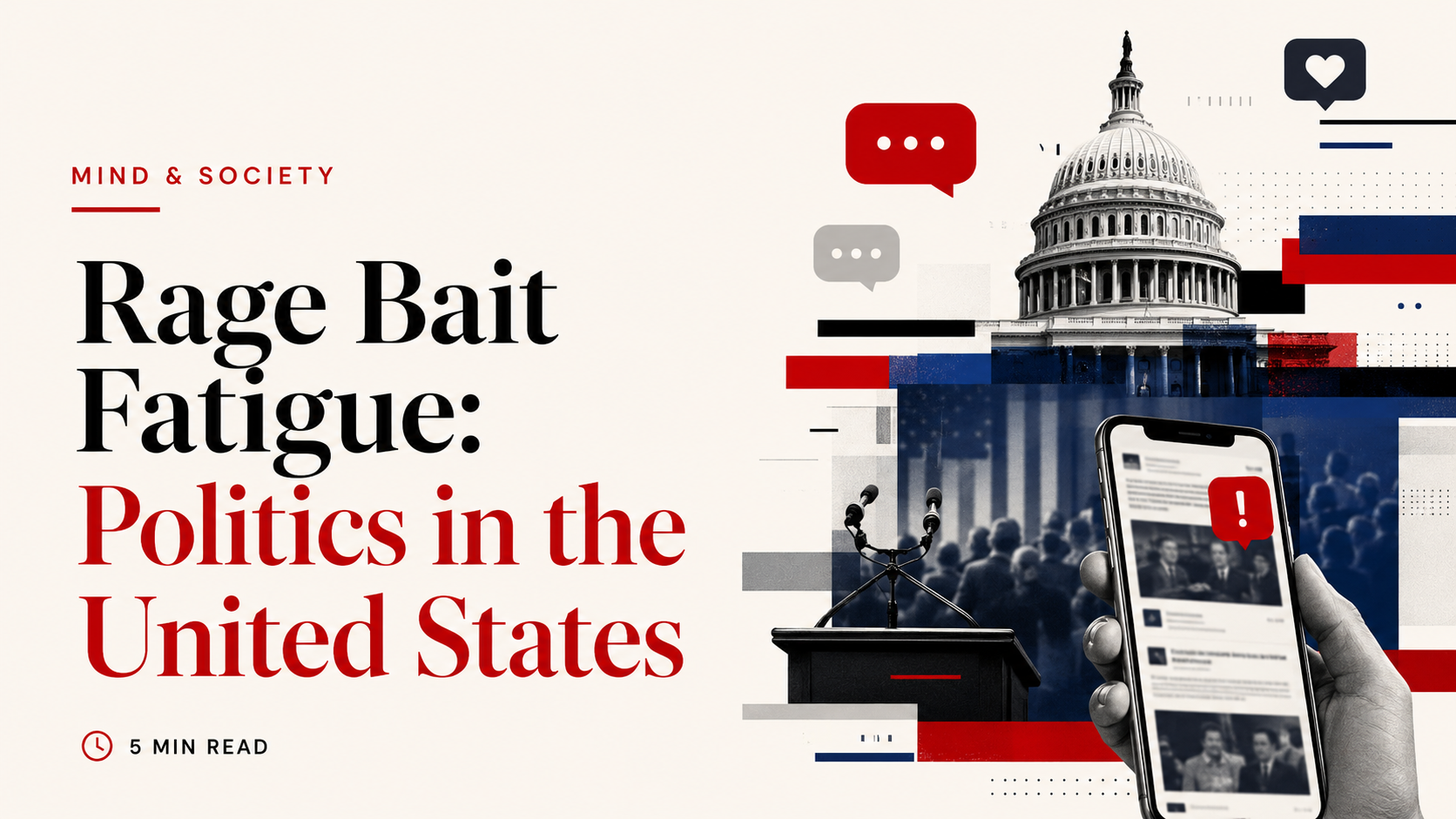
Your attention is worth money. And anger and fear are what sell it.
Platforms and media don't make money when you're informed. They make it when you're engaged, and nothing keeps you engaged like anger and fear working together. Anger gets you to react. Fear keeps you checking back. They're the two pieces of political ammunition that never miss, so the system loads them on a loop, a bad thing, then a worse one, that never resolves.
This isn't a hunch. Researchers studied 400,000 news videos and found the same pattern every time: the content that condemns the other side wins the most engagement. The angrier and more afraid it makes you, the harder you engage.
And it does something to your mind. Not tired, you know tired. This is the fog. Can't focus, can't decide, reading the same sentence four times. Your brain running on fumes.
That's rage bait fatigue. And almost no one is naming it.
You're not imagining it, and you're not alone
Clinicians have a name for the broader version of this: political anxiety. It's rising fast, and therapists across the country are reporting a surge of people walking in distraught about the news.
And it's not a fringe few. In the APA's latest national survey, the future of the country was the single biggest source of stress Americans named.
77%
adults name the future of the nation as a significant source of stress
Sit with that. This isn't a you problem. It's most of the country, feeling the same thing at the same time and mostly not saying it out loud.
Here's what makes it cruel. Work stress has a Friday. Family stress has a door you can close.
This one has no off-season. No whistle. No moment the feed agrees to leave you alone. That's why a break didn't feel like a luxury. It felt like coming up for air.
Your brain is doing exactly what it evolved to do
Here's the part that actually explains the fog. For as long as humans have lived in groups, we've read the people in charge for one thing: are we safe? Calm at the top, the tribe relaxes. Chaos at the top, everybody stays on alert.
That wiring is ancient. It can't tell the difference between a real threat outside the cave and a push notification. So when the people in charge, on every side, are loud, furious, and always at war, a very old part of your brain quietly decides the danger never ends.
And it never gets the signal to stand down. There's no calm. No resolution. Just the next alert.
Then add the part nobody talks about: the crash. Most of us remember a time the country felt like it was finally moving. Hope lifts your whole baseline. And every time that hope drops out from under you, the fall costs something. Do that on a loop for a decade and you're not just stressed. You're grieving a momentum you can't feel anymore.
The performance is the point
You've clocked it. The dancing. The wrestling-style hero-and-villain theater. The manufactured feuds. It feels performative because it is a performance, and the performance is the product.
Performative content travels. It stops the scroll. Remember those 400,000 videos? This is what the winners looked like. And one major platform's own leaked documents admitted the quiet part: the algorithm change rewarded outrage.
You don't have to like it for it to work. That's the whole trick. Outrage grabs your attention before your taste ever gets a vote.
So that feeling you've had for years, that something is being done to you, isn't paranoia. The content is the bait. Your attention is the catch. The fog you're left with is the hook still sitting in your jaw.
What it's actually doing to your body
When you absorb threat signals all day with no resolution, your body does the only thing it knows how to do: it stays ready. This is hyper-vigilance. The fight-or-flight system switched on and left on, sometimes for months or years.
That's why the symptoms are physical:
The naps that swallow an afternoon. The 2 a.m. doomscroll. The clenched jaw. Reading the same paragraph four times and keeping none of it.
None of that is malfunction. It's threat-detection running when it should be resting. And a body that never gets the all-clear pays for it eventually: sleep, mood, the slow grind of chronic stress.
How to starve the machine
You can't out-discipline an industry built by people whose job is capturing your attention. But you can stop feeding it. Four moves that actually work:
Switch the stream for a summary. The 24-hour feed is designed to never resolve, that's the business model. A once-a-day read from one source you trust gives you the information without the drip. You won't miss what matters. You'll miss what was engineered to upset you.
Call the play while it's happening. When a post spikes your heart rate, name it: this was built to do exactly this. Naming the mechanism pulls the wheel back from the reactive part of your brain to the thinking part. The trick only works in the dark.
Give your body the all-clear the feed never will. A walk, a real conversation, slow breathing. The point isn't relaxation, it's signaling to your nervous system that the threat passed, so it can finally stand down. You're closing a loop the machine is built to keep open.
Guard the edges of your day. No feed in the first or last waking hour. Those two windows set your sleep and your mood, and they're the cheapest boundary with the biggest return.
Staying informed was never the problem
Caring about your country and protecting your mind were never supposed to be opposites. The feed just profits when you believe they are.
Rage bait fatigue isn't a character flaw or a diagnosis. It's the predictable result of a system that runs on your anger and fear and bills your attention for it. Now you have a name for it. Naming the mechanism is how you stop running on its schedule and start running on yours.
And if it's already bled into your sleep, your relationships, or your ability to be present in your own life, that's worth more than a better screen-time setting. It's worth talking to someone who understands the specific weight of this moment.
Ready to feel like yourself again?
Dr. Monika Diaz is currently accepting new patients and has worked with people navigating political anxiety.
Book Your Appointment TodayEnjoyed this article?
Get notified when we publish new insights.